- Facial Aging Morphotypes: Why There Is No Universal Formula for Youth
- A Detailed Overview of the 4 Main Types of Facial Aging
- 1. Tired Type of Aging
- 2. Fine-Wrinkle Type of Aging
- 3. Deformation / Gravitational Type of Aging
- 4. Muscular Type of Aging
- How to Choose a Rejuvenation Method: The Best ANACOSMA Procedures for Each Type
- Prevention Tips: How to Slow Down Aging at Home
Many patients look at photographs of themselves taken ten years ago and perceive age-related changes as something abstract and distant. They invest in expensive skincare products labelled “anti-age,” regularly have facial massages, and hope that favourable genetics or a flawless lifestyle will create the illusion of complete protection. For some time, it may seem that facial skin aging types are merely theoretical classifications found in medical textbooks and have little to do with reality.
Facial Aging Morphotypes: Why There Is No Universal Formula for Youth
The first signs of aging rarely appear suddenly. They usually reveal themselves through subtle changes: a barely noticeable shadow in the nasolabial fold or a tired appearance around the eyes that becomes increasingly difficult to conceal. At this point, patients begin to realise that their usual skincare routines no longer provide the desired result, naturally raising concerns about the causes of these changes.
Aging is a genetically determined, inevitable, and highly individual process. Every person experiences it at their own pace, and its visible manifestations can differ significantly. There is no universal rejuvenation method: a treatment that restores skin tone in one patient may aggravate ptosis in another. While patients search for effective solutions, the ANACOSMA team has been successfully managing these processes for many years, transforming theory into consistent results in clinical practice.
A Detailed Overview of the 4 Main Types of Facial Aging
How can you determine your facial aging type accurately? A visual assessment of the epidermis alone is not enough. It is necessary to analyse the anatomy of the deeper structures, including the distribution of subcutaneous fat, the tone of the facial muscles, and the condition of the blood vessels.
You have probably seen photographs of well-known people demonstrating different facial aging patterns as they grow older. These examples make it clear that involutional processes follow specific anatomical patterns. Aesthetic medicine specialists use these markers to distinguish between the different types of facial aging.
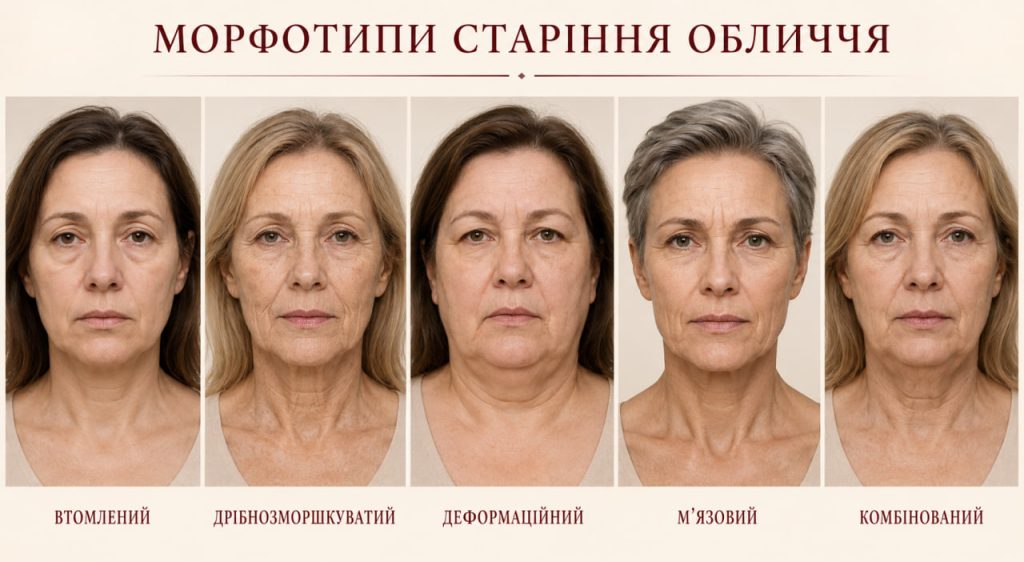
1. Tired Type of Aging
This facial aging type is considered the most favourable for correction. It is commonly seen in patients with an asthenic or normosthenic body type and an oval face shape.
Clinical signs: The face looks rested in the morning, but a noticeable loss of tone becomes visible by the evening. Common signs include drooping corners of the mouth and outer corners of the eyes, a more pronounced tear trough, an apparent loss of volume in the midface, and a dull complexion.
Why it happens (pathogenesis): This is how loss of tone manifests in the tired type of aging. Slower capillary blood flow reduces the oxygen supply to the tissues, resulting in a dull complexion. A tendency towards lymphatic congestion and weakening of the muscles creates the appearance of a tired, “drooping” face by the end of the day.
2. Fine-Wrinkle Type of Aging
This type is most commonly found in patients with a low body weight, naturally dry skin, and a genetically thin layer of subcutaneous fat.
Clinical signs: The clear advantage of this type is that the contour of the lower jaw remains well defined, while gravitational tissue displacement is minimal. However, the epidermis develops a dense network of fine lines relatively early, particularly around the eyes (“crow’s feet”), around the lips (“smoker’s lines”), and on the cheeks.
Pathogenesis: The face loses its youthful appearance due to a chronic lack of natural moisture and protective lipids. Because the natural layer of subcutaneous fat is very thin, the skin quickly loses elasticity and effectively “shrinks,” developing fine folds resembling delicate, dry parchment.
3. Deformation / Gravitational Type of Aging
This is the most common morphotype among patients of Slavic origin. It generally develops in people with dense skin and a well-developed layer of subcutaneous fat. It is also frequently classified as the edematous-deformation type of aging.
Clinical signs: Fine superficial wrinkles are usually minimal. However, gravitational ptosis causes the soft tissues to shift downwards. Pronounced jowls, puffiness, under-eye bags, deep nasolabial folds, and a double chin develop. The facial contour gradually loses its definition.
Pathogenesis: With age, the natural retaining ligaments weaken and can no longer support the dense, heavy facial fat compartments. Gravity causes them to descend. Fluid retention significantly aggravates the situation: adipose tissue absorbs water like a sponge, making the face heavier and distorting its contour.
4. Muscular Type of Aging
The muscular type of aging is genetically more common among people of Asian descent, although it is also found in Europeans with well-developed facial muscles.
Clinical signs: The face retains youthful proportions, firmness, and clearly defined contours for a long time. Changes may then become noticeable quite suddenly: deep vertical folds develop over a relatively short period, particularly in the glabellar area and nasolabial triangle. Loss of cheek volume becomes visible, together with a persistent tendency towards pigmentation.
Pathogenesis: Patients with this type have strong, active facial muscles but very little subcutaneous fat. Over time, the muscles become tense, shorten, and pull the skin inwards, creating deep folds. At the same time, the lack of subcutaneous fat can make the face look slightly hollow or gaunt.
How to Choose a Rejuvenation Method: The Best ANACOSMA Procedures for Each Type
Once the anatomical pattern of aging has been clearly identified, choosing a rejuvenation strategy becomes a precise medical decision. At ANACOSMA, highly qualified doctors combine leading international technologies with proprietary techniques to effectively prevent and correct changes associated with each morphotype:
| Aging type | Clinical objective | Priority treatments at ANACOSMA |
|---|---|---|
| Tired type | Stimulate lymphatic drainage, control swelling, restore hydration balance, and improve muscle tone | Microcurrent therapy, biorevitalisation, facial contouring |
| Fine-wrinkle type | Regenerate the dermal framework, improve tissue density, and correct moisture deficiency | Laser rejuvenation, photorejuvenation, polynucleotide injections, botulinum toxin therapy, mesotherapy |
| Deformation type | Correct and compact subcutaneous fat, strengthen the SMAS layer, and lift the tissues | Ultherapy ultrasound SMAS lifting, microneedle RF lifting, and thread lifting. When indicated: surgical facelift or lifting of individual facial areas, blepharoplasty, or endoscopic lifting |
| Muscular type | Reduce facial muscle hypertonicity and restore lost anatomical volume | Botulinum toxin therapy to reduce hypertonicity, facial contouring with fillers or Radiesse volumisation, facial liposculpture, and BBL treatment for pigmentation |
ANACOSMA specialists note that aging morphotypes are rarely diagnosed in their pure form. Most patients have a combination of different features, which is why treatment protocols and rejuvenation strategies at the clinic are always tailored individually.
Prevention Tips: How to Slow Down Aging at Home
Home skincare is a daily investment that prolongs and enhances the results of professional treatments:
- For the tired type: Stimulate blood circulation by using vitamin C serums and performing self-massage with a facial roller.
- For the fine-wrinkle type: Cleansing should always be gentle and free from aggressive scrubs. Choose creams containing ceramides, which help restore the hydrolipid barrier.
- For the deformation type: Minimise your intake of sweet and salty foods, especially in the evening. Add caffeine-based creams to your skincare routine to help prevent lymphatic congestion.
- For the muscular type: Help control excessive facial muscle activity with micro-relaxing peptides and protect the skin from pigmentation by using SPF 50+ throughout the year.
The main secret is consistency, as the right skincare routine prepares the skin to respond more effectively to professional energy-based treatments.
Allow yourself the luxury of simply enjoying life while entrusting the challenges of aging to the ANACOSMA team.